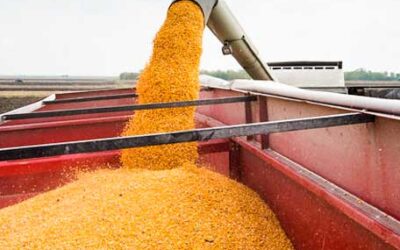
Corn residue distribution may have significant impact on soybean yields
By Shaun Casteel, Purdue Extension Soybean Specialist
Start with the end in mind. This is one of the phrases that have stuck with me since high school. This is the idea of knowing what our goal is and how to get there.
My daughter recently ran her first cross country race. The course was set up where the starting line was to the side of the finish line. She knew where she wanted to finish, but there were two laps of unknown trails that had gravel and grass in addition to hills and hollers. She persevered and finished the difficult course as best as she could.
Farming is much the same way. We know where we want to end – a good harvest – but you do not know the obstacles that lie ahead during the growing season. In both scenarios, we are to train and prepare as much as possible to improvise, adapt and overcome.
You might think I am talking about preparations for this harvest to finish the 2026 race. We certainly want to prepare for the best harvest possible, so we do not leave anything in the field due to poor settings of reel, sieves and concaves. Yes, we need to mindful of all of these and more to maximize our 2026 crop.
However, I want to draw your attention the effects that this corn harvest – yes, corn. I did not mistype – can have on 2027 soybean crop. Proper combine settings and field management can have a cascading effect on soybean performance and even yield.
It is not a secret that corn and soybean yields have been remarkable during the last few years. The high yields are accompanied by greater residue, which can be managed multiple ways depending on field history, soil type, latitude and more.
My goal is for our combines to be set in the best possible arrangement for success in 2026 harvest – do not leave anything at the table – while setting up 2027 soybean crop with one less obstacle.
Soy after good corn year
I have noticed for years that a soybean crop can be a little sluggish following good corn years. The direct connection can be drawn that as corn yield increases so does corn stover (i.e., residue). Now we couple that with earlier and earlier plantings of soybeans, we have created cooler growing conditions that may slow soybean development, limit mineralization of soil organic matter (such as supply of nitrogen and sulfur), and even raise potential development of disease.

A number of factors come into how to manage this residue and the desire to plant earlier, which can start at the combine, follow with fall management (such as tillage, fertilizer, breakdown products) and end with planting operations (such as row cleaners, active down pressure, starter fertilizer). Those factors will be discussed at another time while we address simply uneven distribution of corn residue.
We followed a soybean field in 2025 that had some uneven emergence that stemmed from the distribution of corn residue (see Figure 1). Soybean stands were slightly lower and a little delayed in development in the areas with more corn residue. The corn residue pattern of was consistent with the worse areas every 30 feet, which match up with the center of the combine passes (12-row head).
Soybean population was reasonable (approximately 90,000 plants per acre) and there would not have been any benefit in overseeding more soybeans. Soybean population was better ( about 105,000 plants per acre) in the areas with less corn residue (such as the outer edge of the 12-row header pass), but I would not expect any yield differences based on plant population alone.
Soybean growth and canopy closure was more advanced in this same area, which was likely due to warmer soils that influenced soybean development and mineralization of nitrogen and sulfur.
Corn residue distribution
We continued to follow this soybean field in 2025 and harvested it with our small plot combine that has a 5-foot header. The soybeans were slightly behind in maturity in the middle of the previous corn harvest and yielded 68.3 bushels per acre.

We harvested 7.5 and 15 feet from the middle of the previous corn harvest, which also aligned with a moderate amount of corn residue and the least amount of corn residue, respectively. The soybean yields stair-stepped up to 74.4 and nearly 80 bushels per acre as we went further away from the center of the corn harvest. The yield difference was more than 6 and 11 bushels per acre due to residue levels or nearly 15 percent yield hit.
I wager that most of us do not see this yield effect with our yield maps, because the gradient of yield differences is averaged across our soybean headers in 25- to 400-foot chunks. We might think that field should have been an 80-bushel field, but something happened during seed fill to take about five bushels off the top end.
Now that is possible, but maybe just maybe we need to look at residue distribution.
I suggest that we start with the end in mind. Let’s take the time to set our combines for the best harvest for 2026 crop – corn and soybean – while preparing for the 2027 crop with better corn residue distribution.
Posted: September 18, 2026
Category: Indiana Corn and soybean Post - September 2026, ISA, News, Purdue Extension, soybeans