Gov. Braun says he will continue to advocate for Hoosier farmers
By Dave Blower Jr.
Indiana Gov. Mike Braun covered an array of farm topics in a “Fireside Chat” with Courtney Kingery, CEO of the Indiana Soybean Alliance (ISA), the Indiana Corn Growers Association (ICGA) and the Indiana Corn Marketing Council during the Indiana Ag Policy Summit on July 30 at the Boone County Fairgrounds.
The Summit is an annual policy-focused program presented by the ISA’s Membership and Policy Committee and ICGA. Approximately 160 farmers, industry stakeholders, legislative staff and state and federal lawmakers attended the Summit.
In addition to Gov. Braun, U.S. Reps. Jim Baird (R-Dist. 4), Jefferson Shreve (R-Dist. 6), State Sen. Brian Buchanan (R-Lebanon, Ind.) and State Reps. Beau Baird (R-Greencastle, Ind.), Mike Aylesworth (R-Hebron) and Mark Genda (R-Frankfort) discussed ag policy with the Hoosier farmers. Also, ISDA Director Don Lamb presented his “State of Indiana Agriculture” speech.
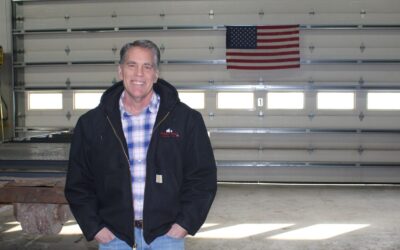
Braun said he was an advocate for Hoosier farmers while serving in the U.S. Senate and added he was one of two senators with a farm background on the Senate Ag Committee. “Indiana farmers feed, clothe and fuel America, and I’m glad to have the opportunity to share the wins we secured for Hoosier farmers this year: Cutting property taxes and creating new opportunities to get fresh, local produce into Indiana schools and homes through our Make Indiana Healthy Again initiative,” Gov. Braun said.
Braun said he will continue to seek common sense solutions to farm policy issues at both the state and federal levels. He discussed protecting agriculture from losing crop protection products from potential Make America Healthy Again (MAHA) regulations, expanding available energy options, improving rural infrastructure and maintaining Indiana’s position as a strong ag state.
ICGA President Chris Cherry, a farmer from New Palestine, Ind., was pleased to hear that Gov. Braun will continue to advocate for farmers by supporting crop protection products from potential regulation. “Glyphosate, atrazine and other pesticides are important,” he said. “Take those away from us, and the cost of production is going to go up and our productivity will go down. Gov. Braun has had conversations with President Trump, USDA Secretary (Brooke) Rollins and RKF Jr. (Health and Human Services Secretary Robert F. Kennedy, Jr.) about how important it is to keep those products. I am hopeful that they won’t take those products away.”
Biofuels boosting soybean oil market
No Bull Founder and Market Analyst Susan Stroud told Summit attendees that the Trump Administration has boosted the soybean oil market by proposing higher volume requirements for biodiesel blends of diesel fuel. In June, the EPA announced it would increase the blend volume requirement from 3.35 billion gallons this year to 5.61 billion gallons in 2026.
In addition, the 45Z Clean Fuel Production Credit is designed to incentivize biofuel producers to use feedstocks with lower carbon intensity scores – like soybeans or corn from farms that utilize sustainable practices. While the credit would go to biofuel producers, farmers could receive premiums with demand increasing for domestically sourced, sustainable feedstocks.
Stroud said domestic demand for soybeans has been strong, but domestic demand also increases the cost of exported soybeans. She added that getting new trade deals in place soon would help stabilize exports. In the past soybean meal has been the driver for soybean prices. For several years now, she said, the U.S. soybean market has become driven by the value of soybean oil.
“Half of all meal demand here in the United States goes to broiler chickens, which is great, but we’re going to have to find more ways to export soybean meal so that we can maintain crush margins and keep crushing for oil,” Stroud said.
Value of checkoff programs
Two portions of the Summit covered corn and soybean checkoff programs. Harrison Pittman of the National Agriculture Law Center gave a presentation titled, “The State and Federal Checkoff Landscape.” Following that speech, Kingery led a farmer panel on the topic featuring Mike Beard, a Frankfort, Ind., farmer and former ISA, ICGA and Indiana Pork board member; Brian Martin, a Williamsport, Ind., pork producer and Indiana Pork board member; and ICGA President Chris Cherry.
Pittman said Indiana is a major U.S. soybean producer, and checkoffs like ISA are the avenue for private entities, farmers, to invest in the soybean industry. But he noted that Indiana is one of only a few soybean-producing states that does not have a state soybean checkoff law. ISA operates under the federal soybean checkoff law. Pittman added that if the federal law were to ever cease, then Indiana’s checkoff program would not be able to continue. However, he added that Indiana could adopt a state soybean checkoff enabling language that would serve as a safety net and only be triggered if the federal checkoff were to cease.
Beard said he initially got involved in checkoff work as a pork producer in the late 1990s when the pork market was suffering. “I got involved because I didn’t think the pork checkoff was doing a good job addressing the crisis in 1998 and 1999,” Beard explained. “I got on the board because I thought I could change things. I could make things right. I learned an awful lot during that first year on the board. Many of the programs the pork producers were involved in were trying to save Indiana’s pork producers from extinction. … My advice to those who serve on these boards or want to serve is to organize and work together so we can speak with one voice. We need to play together in the sandbox and not throw sand at each other.”
Baird, Shreve greet farmers
The Summit’s formal program ended at 12:30 p.m. allowing time for farmers to interact with lawmakers or legislative staff, eat lunch and visit the Technology Showcase. U.S. Rep. Baird and U.S. Rep Shreve posed for photos with constituents and talked farm policy with farmers during this time.
Baird is on the House Ag Committee, and he listened to several farmers who hope Congress will adopt a new farm bill this year. Both Baird and Shreve hosted Indiana farmers earlier this month as they visited representatives on Capitol Hill.
Many sponsors supported this year’s Ag Policy Summit. The Gold Level sponsors were Farm Credit Mid-America, Bayer Crop Science and Corteva Agriscience. Indiana Pork was the Silver Level sponsor. The Bronze sponsors were FMC, Conexus Indiana, Beck’s Hybrids, Halderman Real Estate & Farm Management and First Farmers Bank and Trust. The Break sponsor was FMC, and the lunch sponsor was the United Soybean Board.
ICGA and M&P rely on event sponsorship and membership dollars to advocate on behalf of Hoosier farmers. For more information about the summit, membership or corporate partnerships, contact Khyla Goodman, Industry Affairs Outreach Manager for M&P and ICGA, at 317-614-0377 or email kgoodman@indianasoybean.com.
Posted: September 13, 2025
Category: 2025 Events, 2025 Indiana Ag Policy Summit, ICGA, Indiana Corn and Soybean Post - September 2025, Industry Affairs, ISA M&P, Membership and Policy, News