ASA Priorities: farm assistance program, nutrition guidelines, and biofuels
By Blair Shipp, American Soybean Association
As soybean farmers turned the calendar to 2026, the American Soybean Association intensified its push for policies that deliver both near-term stability and long-term market growth. That message was reinforced by year-end farm assistance, new federal nutrition guidance and growing momentum behind biofuels as a cornerstone of domestic soybean demand.
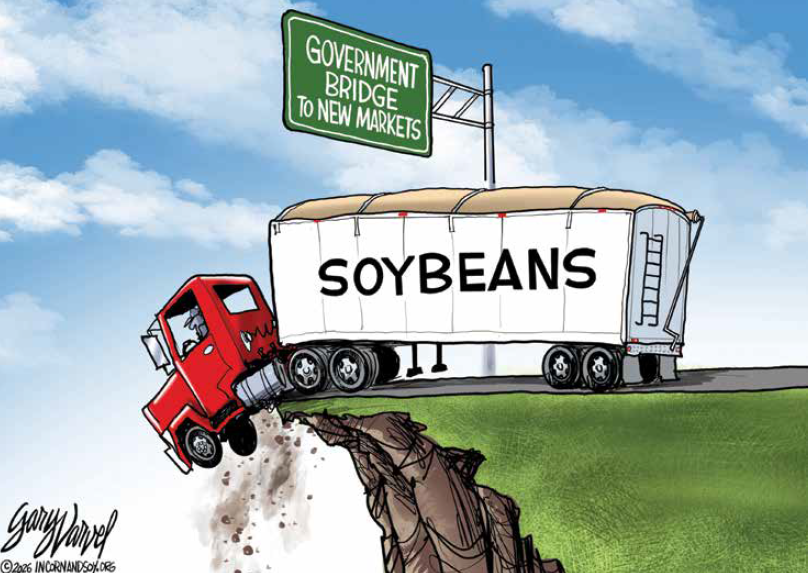
The effort follows the USDA’s Dec. 31 announcement of Farmer Bridge Assistance payments, which are intended to help offset losses driven by high input costs and prolonged trade disruptions. Under the program, soybean farmers will receive $30.88 per acre. ASA acknowledged the administration’s recognition of the economic pressures facing agriculture but said the payment rate does not fully reflect the scale of losses farmers have absorbed over multiple years.
“While the assistance provides some relief, farmers need strong, reliable markets to guarantee the long-term success of the U.S. soybean industry,” said ASA President and Ohio soybean farmer Scott Metzger. “Short-term support must be paired with policies that grow demand and provide certainty for farmers making decisions for the next crop year.”
Building on that message, ASA joined more than 70 agricultural organizations in a Jan. 15 letter to congressional leadership urging additional economic support for farmers facing sustained losses. The coalition warned that record-high input costs, historically low commodity prices and a widening agricultural trade deficit have left many producers operating with negative margins and limited access to financing.
The letter emphasized that recent investments included in the One Big Beautiful Bill Act and USDA’s Farmer Bridge Assistance program represent important first steps, but do not fully cover cumulative losses across the farm economy. The groups urged Congress to act quickly to provide gap-filling support while longer-term demand-building policies are finalized.
Biofuels a durable solution
At the same time, ASA continues to stress that the most durable solution for soybean farmers is expanded domestic demand, particularly through biofuels policy. The association is urging the Environmental Protection Agency to finalize strong Renewable Volume Obligations for 2026 and 2027 that include robust biomass-based diesel volumes and prioritize American-grown feedstocks.
ASA also is calling for timely guidance on the 45Z Clean Fuel Production Credit to provide certainty for biofuel producers and encourage continued investment. According to the association, clear and consistent biofuels policy strengthens rural economies, supports domestic energy production and creates reliable demand for soybean oil.
That message received a boost in mid-January when White House senior counselor for trade and manufacturing Peter Navarro published an op-ed highlighting the importance of domestic markets for U.S. soybean producers. In the piece, Navarro emphasized that processing more soybeans at home would reduce vulnerability to China, secure agricultural supply chains and stabilize prices.
Navarro pointed to biofuels as a key tool to anchor soybean demand domestically, noting that redirecting soybeans into renewable fuel production would strengthen energy security and support farmers. His op-ed echoed ASA priorities, including support for a proposed discounted credit for imported fuels and feedstocks in the 2026 to 2027 Renewable Volume Obligations.
ASA leaders said the op-ed reflects ongoing conversations with the administration about trade challenges and domestic market opportunities. In November, ASA CEO Stephen Censky and U.S. Soybean Export Council CEO Jim Sutter met with Navarro to discuss strategies to expand domestic demand for U.S. soybeans.
ASA welcomed Navarro’s public support for biofuels and domestic processing, calling it a positive step as the administration continues deliberations on final Renewable Volume Obligation rules.
Federal dietary guidelines
In addition to economic and energy policy, ASA is engaging federal officials on nutrition policy following the release of the 2025 to 2030 Dietary Guidelines for Americans on Jan. 7. While the guidelines are nonbinding, they shape nutrition standards for school meals, military and veterans programs and other federal food initiatives.
ASA welcomed the guidelines’ recognition of soy as a healthy, plant-based protein and their emphasis on prioritizing healthy fats, including oils rich in essential fatty acids such as soybean oil. However, the association raised concerns about supporting materials that question soybean oil processing and suggest seed oils may contribute to inflammation.
According to ASA, those claims rely on selectively cited animal studies and overlook a substantial body of scientific evidence demonstrating the safety and health benefits of soybean oil. Major health authorities, including the American Heart Association and the World Health Organization, continue to recommend replacing saturated fats with unsaturated fats. Soybean oil also maintains a qualified health claim from the Food and Drug Administration for reducing the risk of heart disease when substituted for saturated fat.
“Soybean oil and soy protein play a critical role in the health and nutrition of Americans,” Metzger said. “U.S. soybean farmers are proud to grow a heart-healthy and high-protein crop that can feed the country and the world.”
As policy debates continue in Washington, ASA said its focus remains on advancing biofuels, strengthening domestic demand and ensuring soybean farmers, including those in Indiana, have the tools and markets needed to remain competitive for the long term.
Posted: January 27, 2026
Category: Indiana Corn and Soybean Post - January 2026, ISA M&P, News