Timing of corn harvest is important and could impact kernel dry weight
By Evan Cohagan, Purdue Graduate Research Assistant and Dan Quinn, Purdue Extension Corn Specialist
Each fall and winter, one common question that we often receive is specific to the idea of “phantom yield loss” or “invisible” reductions in harvested yield that occur when corn is left standing in the field after physiological maturity. In many cases, phantom yield loss is hypothesized as losses in yield due to losses in kernel dry matter caused by seed respiration as harvest is delayed.
Early research conducted in Indiana suggested that kernel dry matter losses could occur during field dry down as corn grain moisture declined below approximately 25 percent (Nielsen, 1996). More recently, private and industry-led trials have continued to raise concerns about so-called “phantom yield loss,” often attributing perceived yield reductions to seed respiration during extended field dry down. (www.agweb.com/news/crops/farm-journal-test-plots/farm-journal-test-plots-phantom-lurks-your-corn-fields)
In contrast, recent peer-reviewed research from Iowa has largely refuted these claims (Parvej et al., 2019). Given these contrasting findings and continued grower interest in this topic, we sought to re-examine the effects of harvest timing on kernel dry matter using current hybrids and modern management practices in 2025 to better understand how harvest decisions influence corn yield potential. This project is also supported by the Indiana Corn Marketing Council.
Corn physiological maturity (growth stage R6), commonly referred to as “black layer,” represents the point at which corn kernels reach their maximum dry matter accumulation. From a yield standpoint, this is important because grain yield is effectively fixed once black layer forms. Physiological maturity typically occurs 55 to 65 days after silking (R1 growth stage) and when kernel moisture is still relatively high, often near 30 to 35 percent. After R6, the primary change occurring in the crop is grain dry down.
This process is driven largely by environmental conditions and occurs at an average rate of about 0.5 percentage points of moisture per day, though this rate is often highly variable due to multiple factors. Dry down tends to be fastest in September, slows considerably in October, and becomes minimal by November as temperatures decline. Cool temperatures, high humidity, and limited solar radiation can further slow dry down and prolong the period corn must remain in the field until it is ready to harvest.
In addition, hybrid genetics can also influence post-maturity dry down. Traits such as husk tightness, ear orientation, husk leaf number, and tip exposure can all affect the rate at which moisture can escape. In addition, longer-season hybrids often reach physiological maturity at higher moisture levels, which can delay harvest readiness even if they eventually dry at similar rates. These genetic differences help explain why harvest timing can vary substantially among hybrids planted in the same field.
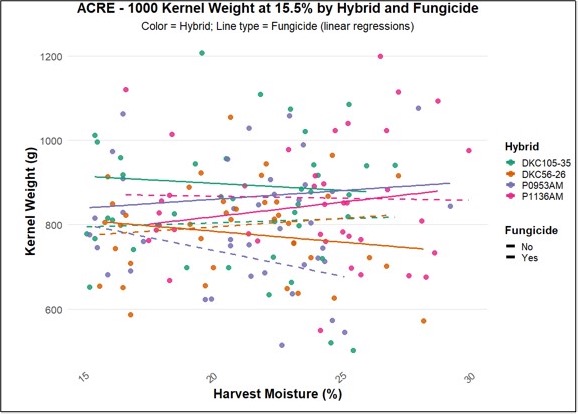
Beginning in 2025, research trials were established in West Lafayette (ACRE) and Columbia City (NEPAC), Indiana to assess the impacts of harvest timing on kernel dry weight across different hybrids (Pioneer P1136AM, P0953AM, and Dekalb DKC105-35, DKC56-26) and with and without the inclusion of a foliar fungicide application at the R1 growth stage (Figures 1 and 2).
In this study multiple ears (15+) were sampled from each individual plot beginning at a grain moisture of 28 percent and finishing at a grain moisture of 16 percent, with additional targeted harvest intervals of 24 percent and 20 percent. Each individual ear that was sampled was assessed for sample moisture at the time of harvest and then dried to a consistent moisture and to assess total dry weight via a sub-sample of 1,000 kernels.
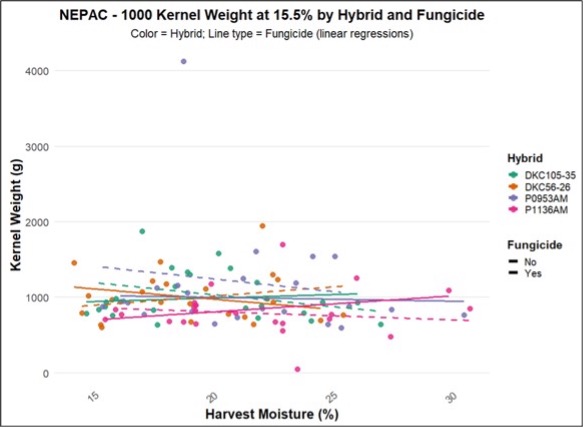
Across our 2025 research trials, we observed no relationship between targeted harvest moisture and kernel dry weight (Figures 1 and 2). Even examining both data figures presented in this article you can notice the “mess” of different colored points and lines which represent different hybrids and the inclusion or exclusion of fungicide.
Overall, this data shows no significant relationship between harvest moisture and kernel dry weight across two Indiana locations, four different hybrids and different management practices in this study. Therefore, our preliminary results suggest that kernel dry weight is not being lost via “phantom yield loss” with the proposed primary mechanism of kernel dry matter losses via seed respiration as harvest is delayed.
This preliminary result tracks very closely with recent research from Iowa which showed across multiple years, planting dates, and hybrids there was no evidence found of kernel dry matter loss during in-field dry down, confirming that yield potential was not declining due to respiration or biochemical degradation of the grain. In addition, the researchers also found grain quality traits, including protein, oil, and starch concentration also changed very little between black layer and harvest, further supporting the conclusion that kernels themselves are not losing yield or quality as they dry in the field.
Therefore, recent research has shown that kernel dry matter remains stable after black layer and as harvest timing is delayed, meaning yield potential is preserved across typical harvest windows. However, harvest timing still matters because yield losses can occur through physical mechanisms rather than physiological ones.
As harvest is delayed, risks of stalk lodging, ear drop, disease development (e.g., ear rots and mycotoxin accumulation), insect damage, and harvest inefficiencies increase, particularly later in the fall. In addition, grain test weight generally improves as grain dries but reaches a plateau once grain reaches a moisture of 20-23 percent, after which further field drying provides limited grain quality benefit, while increasing exposure to potential weather-related losses.
Together, these findings further clarify that so-called “phantom yield loss” is likely not driven by kernels losing weight via seed respiration, but likely by reduced grain recovery due to a multitude of potential factors as corn stands longer in the field. From a management standpoint, the goal is to balance grain moisture, drying costs, and field loss risk.
In many cases, harvesting before grain moisture drops below approximately 20 percent, especially in fields with weak stalks or high disease pressure, can help protect yield and improve harvest efficiency.
Posted: March 20, 2026
Category: ICMC, Indiana Corn and Soybean Post - April 2026, News, Purdue Extension