ICMC-funded research at Purdue shows higher yields from increased management


BY MALENA BARTABURU, MSC Student, Purdue University
AND DAN QUINN, PH.D., Purdue Assistant Professor of Agronomy
With recent increases in corn grain prices, weather variability, nutrient deficiencies and losses, emerging diseases, and overall declines in yearly percent yield gains, many farmers have been driven toward using different tactics and technologies to improve corn production.
One popular strategy by farmers to maintain yield potential and optimize production is through combinations of higher seeding rates, additional macro and micronutrient fertilizer and prophylactic chemical input applications. However, these management decisions can be expensive, unnecessary and may increase the potential for biological resistance and nutrient losses when used improperly.
In 2022, with Indiana Corn Marketing Council (ICMC) funding, the Corn Agronomy Program at Purdue University established a statewide research trial to evaluate corn physiological, yield and economic responses to single and combinations of different management intensities and commonly marketed inputs. In addition, with recent claims of improved “stay-green” and plant health benefits from various intensive practices and applied inputs, Purdue researchers wanted to understand how intensive management can impact late-season grain fill duration and kernel weight accumulation in corn.
The research trials encompassed both small-plot and field-scale research trials spanning from southern, central and northern Indiana. The goals of this research were to: – Evaluate corn growth, yield and economic response to management practices and applied inputs alone and in combination across multiple locations. – Determine the impact of combined intensive practices and corn fungicide applications on grain fill duration and kernel weight accumulation.
The experiment was first established in May in three locations (four total fields) throughout Indiana. The locations included: West Lafayette, Ind. (ACRE), Butlerville, Ind. (SEPAC, 2 fields) and Columbia City, Ind. (NEPAC). Three out of the four research fields were field-scale trials with plots that measured 30 feet wide (12, 30-inch rows) and ran the entire length of the field (500- to 1,000-feet long).
The center 6-8 rows of each of these plots were harvested with a commercial combine and a calibrated yield monitor to determine treatment differences. A small-plot trial was established at ACRE for more intensive plant and corn kernel development measurements.
At each location Purdue researchers incorporated eight total treatments described below:
- Control treatment (C) based on Purdue University seed rate and nitrogen (N) fertilizer recommendations of 30,000 seeds per acre and N fertilizer application as starter (2×2) and V5 growth stage sidedress
- C + sub-surface banded starter (2×2) fungicide (Xyway)
- C + 20 percent increase in corn seeding rate (36,000 seeds per acre)
- C + sulfur fertilizer (5.2 gallons per acre as ammonium thiosulfate (ATS) at V5 sidedress)
- C + foliar micronutrients (zinc, manganese, and boron applied at the V6 growth stage)
- C + late-season N application (starter N (2×2) + V5 sidedress N + V10-12 growth stage sidedress N surface-banded with drop tubes on a sprayer, total N rate remained the same as other treatments)
- C + foliar fungicide applied at the R1 growth stage (Delaro complete)
- Intensive treatment: all additional inputs and management practices applied together
Preliminary research trial summary
The 2022 research yield and profitability results are presented in Table 1 and include the average treatment cost per acre, grain yield average and net profit average. Preliminary yield results from Indiana showed the intensive management treatment out yielded the control at all three locations by an average of 24 bushels (bu) per acre (Table 1).
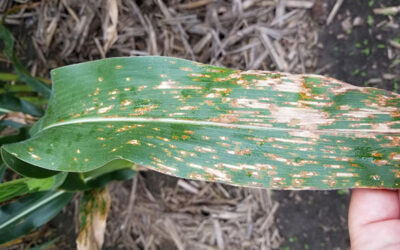
In addition, despite the added cost, the intensive treatments increased net profit compared to the control treatment by an average of $115 per acre. The inputs with the largest yield responses at all three locations included sulfur (+8 bu at 2 of 3 locations), V10 nitrogen application (+5 bu at 2 of 3 locations), and R1 fungicide (+14 bu at all locations). All three research locations exhibited visual foliar disease (e.g., tar spot, southern rust, gray leaf spot, northern corn leaf blight) which was significantly reduced by the R1 fungicide application, likely driving the observed yield responses.
As well, late-season N application responses were likely due to increased plant N uptake and N use efficiency due to more timely rainfall following the V10-12 N application as compared to observed June drought conditions driving visual N deficiency symptoms and limited plant uptake following the V5 sidedress N only. Visual sulfur fertilizer responses and sulfur deficiency symptoms were also observed at all three locations.
Furthermore, the intensive treatment which contained all applied inputs exhibited greater plant health and stay green potential at the R6 growth stage as compared to the control treatment (Figure 1).
Overall, the preliminary results from this research study highlight the potential for additional inputs and intensive management practices to improve corn yield and profitability when conditions are conducive for responses (e.g., foliar disease, nutrient deficiencies). In addition, soil and tissue test results, kernel growth, dry matter, and weight parameters are still currently being analyzed to help further understand the observed results.
Also, this trial is being performed in collaboration with the University of Kentucky and Michigan State University and will be repeated next year to provide additional data and conclusions. It is important to remember that additional data, years, and locations will help us further understand corn yield benefits from the applied inputs and practices across more environments and weather conditions.
Lastly, the authors would also like to thank ICMC for funding of this project.
Posted: December 19, 2022