First-generation Indiana farmer is working hard to build a future
By Dave Blower Jr.
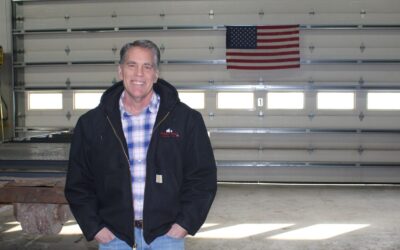
Tom Murphy is a farmer from Chesterton, Ind. That statement alone is an accomplishment for someone with very little farm background.

He grows commercial corn and soybeans and also amylose corn on his farm that touches both Lake and Porter counties. But his interest in agriculture has stretched beyond the daily duties around his farm. Murphy is in his second term on the Indiana Corn Growers Association Board of Directors representing District 1 in the northwest corner of the state.
Murphy often thinks about the challenges, opportunities and friends that helped him get his start.
“I didn’t grow up on a farm. I’m a first-generation farmer. When I was four or five years old, I was obsessed with farm toys and farming in general,” he said. “My grandfather had a farm about a mile south of where we are right now, and I used to just drive my mom bananas to go over there. I would ride on a tractor and help him around the farm; I couldn’t get enough.”
When Murphy was 14, through a friend, he met Gary Dunlap, a farmer from Valparaiso, Ind. Murphy went to work driving a truck and working on Dunlap’s farm. In 2005, he moved out of driving a truck to performing more on-farm work.
“About eight years ago, I went to Gary and said, ‘You know, we need to figure something out. I’ve got kids, and I’ve got a wife. If you want to retire or something, I don’t want to start trying to find a new career at age 45 or 46,’” Murphy explained. “Gary said, ‘No, we’ll figure something out.’ So, it took probably two-and-a-half or three years to get things figured out. We hired some attorneys, and we started a joint venture. Gary still has input, and I have input. Over a certain amount of time, farm decisions would more and more transition to me. He is still involved even though he originally wasn’t going to do much planning, but it’s all good because he is very good at doing the paperwork and the things that maybe I lack a little bit.”
The joint venture between Murphy and Dunlap has been featured in media reports as a different model for transitioning ownership of a farm. Dunlap encourages farmers to work with potential partners and get to know them before entering into a joint venture.
“You can’t just interview somebody and get started,” Dunlap told Indiana Prairie Farmer in an April 2023 story. “Tom worked for me for 11 years, and I knew him very well. I knew that he wasn’t somebody I’d have to push to get things done. It’s a whole lot easier to pull someone back occasionally. I’ve also heard of situations where people tried this, only to find out the new person only wanted to work 9 to 5 and be off every weekend. If they’d known each other well, first, they would have both seen it wouldn’t work.”
Murphy said they don’t agree on everything, but they know each other well enough to make decisions.
“We still bounce ideas off of each other,” he said. “Sometimes we will fight like a son and a father. There are days when I don’t want to talk to him, and he doesn’t want to talk to me. But we will just kind of do what needs to be done. Eventually, we’ll butt our heads, say our peace, and it’ll be fine.”
Preserving the land
Sometimes, those discussions have been about adopting new conservation measures for the farm.

Murphy said he has a field that is surrounded on three sides by the National Lakeshore and on the back there is a steelhead stream. He explained that the sandy soil was eroding into ditches. He decided to look into saving soil by implementing no till practices and cover crops.
Although Murphy admits to a learning curve, he said the time and effort has been worth the extra wait. “Now I can say with the utmost confidence that even though that is not our best ground, it is our highest yielding farm ground,” he said.
In addition to higher yields, Murphy said soil health improvements have led to lower input costs. “We have clay soils that used to be hard to work with in the spring,” he said. “With cover crops, the soils are more relaxed, and we’re seeing improved seed-soil contact and uniform emergence. Our microbes are up, and we don’t have to use as much fertilizer as we did before.”
Murphy advises farmers to start slow and learn from their mistakes. The first year he implemented no-till and cover crops, he said there was a “beautiful stand of corn” about two weeks after planting. When he checked again two weeks later, the corn was nearly gone. Armyworms were the culprit.
“It wasn’t one or two armyworms per plant. I mean we were shaking, and there were hundreds on every plant,” Murphy said. “My agronomist said, ‘You need to spray insecticide on this yesterday’. So, I went and sprayed it, but I learned how to manage that.”
Though Murphy started with less than 100 acres of no-till and cover crops, he now uses those tools on more than 2,500 acres.
Farming in the urban and suburban areas near Chicago, he is sensitive to how the non-farm community impacts how farmers produce a crop. His second reason for adopting conservation practices is to get ahead of the curve on potential government regulations.
“I think I have to figure out different ways to do things for when the government comes in and says, ‘Hey, there’s a problem’” Murphy said. “If we’re not five steps ahead of that curve, we’re going to have to catch up after the regulations come down.”
Representing farmers

Murphy was recruited to the ICGA board by former ICGA board member Mike Beard, a farmer from Frankfort, Ind.
“Mike is just a super person. He’s genuine and he’s a good guy to know and talk to you,” he said of Beard, who termed off of the ICGA board last year. “I truly enjoyed my conversations with him, and I miss him not being on the board. I’m sure he had problems because everyone does. But nothing much seemed to bother him. He was always a happy-go-lucky guy.”
Mike McIntire, a farmer from Lowell, Ind., had represented ICGA in District 1 for nine years, and he was about to term off of the board. Murphy met Beard while preparing for the National Corn Growers Association’s annual Corn Yield Contest. Beard explained that ICGA needed someone to serve in District 1 and encouraged Murphy to apply.
“I was mailed an application; I filled it out; and it was accepted,” he said. “The next thing I know I’ve been elected. It was kind of trial by fire, but that’s how things happen.”
Murphy has discovered that representing farmers does not only mean representing them with lawmakers or on the ICGA board. Representing farmers also means working with his non-farm neighbors and answering their concerns.
“What I have found is just reaching out to people and giving them someone to ask what seems like a stupid question,” he said. “But it’s a question they have and spending five minutes to talk to them about it now really helps. They learn and understand why we do some of the things we do.”
In addition, though, he believes that educating lawmakers is essential, too. In the past, he has hosted U.S. Rep. Frank Mrvan (D-Dist. 1) on his farm and answered many of his questions.
Murphy added that key issues for him include expanding opportunities for marketing ethanol to consumers and keeping an eye on pesticide regulation efforts by the federal government.
A second generation?
Part of the motivating factor for Murphy is the idea that one of his children might want to take over the farm someday. He and his wife, Lori, have three sons, Joe, Cole and Jonathan, and a daughter, Corynne.
Lori also does not have a farm background. “My wife had no idea what she was in for by marrying a farmer,” Murphy said while laughing. “It used to be fun when we were younger. When we first started dating, Lori would come out and ride the tractor with me. Now, not so much, the shine is off.”
He said all of his children have other interests, so it is hard to say at this point if any one of them will want to work on the farm in the future.
“I’m not going to put any responsibility on them for staying on the farm,” he said. “If one of them wants to do it, I hope to help them the way I was helped. And I’m going to do everything I can to make sure that whoever this farm goes to next, it will be a good, healthy farm.”
Posted: July 19, 2025
Category: ICMC, Indiana Corn and Soybean Post - July 2025, News