
Paying attention to nitrogen and sulfur together may be important
By Dan Quinn, Purdue Extension Corn Specialist
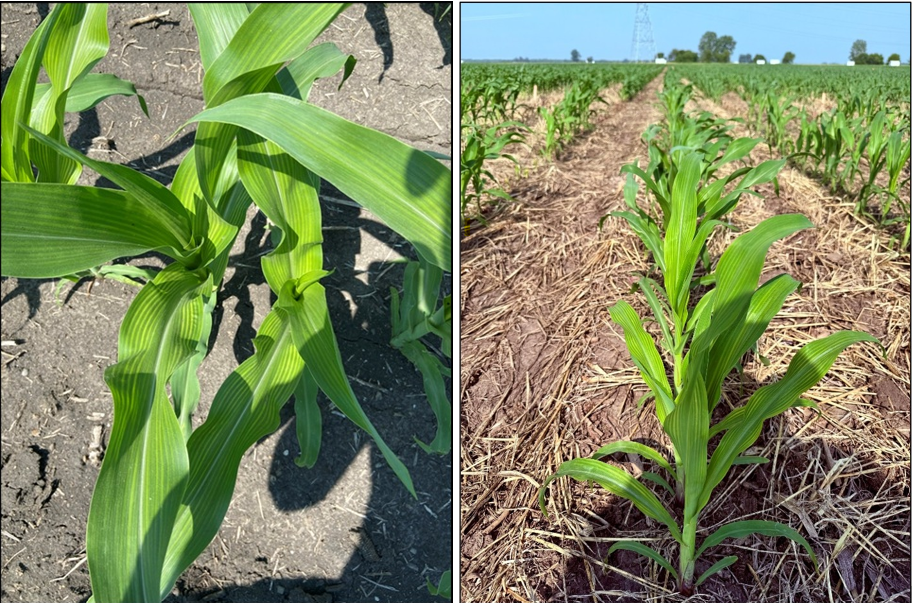
During the past decade, sulfur (S) deficiency symptoms and questions surrounding sulfur fertilizer management in corn have become increasingly more common in Indiana. While sulfur deficiency itself is not a new concept, its interaction with nitrogen (N) management, particularly nitrogen fertilizer rate, has emerged as an increasingly important issue that warrants closer examination.
This article summarizes why N and S are tightly linked in corn production, highlights key preliminary insights from recent research, and explains why understanding and managing the interaction between these two nutrients may be critical for optimizing nutrient management and yield potential moving forward.
Several long-term trends are increasing the risk of S deficiency in Midwestern corn systems and also highlight the need to better understand interactions between N and S fertilization. Atmospheric S deposition has declined substantially over recent decades, modern fertilizers and pesticides provide little incidental sulfur as compared to the past, and steadily increasing corn yields remove greater amounts of S from the field each year.
In addition, management shifts such as earlier planting dates, reduced mineralization of soil organic matter, and greater incidence and adoption of high-carbon systems (e.g., grass cover crops, continuous corn, and increasing post-harvest stover residue due to yield increases) can further restrict sulfur availability through high carbon to S ratios and early-season immobilization (Image 1).
Nitrogen fertilizer rates increase
At the same time as S deficiencies have increased, both agronomic and economic optimum nitrogen fertilizer rates in Midwestern corn systems have continued to increase. Recent analyses indicates that agronomic optimum N rates have risen by approximately 1.1–1.6 percent per year, while economic optimum N rates have increased by 1.4–2.2 percent per year depending on crop rotation.
Together, these trends create a growing potential for nutrient imbalance, particularly when S availability may not keep pace with increasing N fertilizer rates. As a result, understanding how N and S interact within modern corn production systems has become increasingly important.
Both N and S maintain closely related and often interdependent roles in plant growth and development. Both nutrients are essential for protein formation, amino acid synthesis, and chlorophyll production, and their metabolic pathways are highly interconnected. For example, adequate N is required for efficient S assimilation, while sufficient S is necessary for proper N uptake, transport, and utilization within the plant. Consequently, deficiencies or imbalances in one nutrient can directly limit the effectiveness of the other. In addition, S deficiency has been shown to reduce nitrate reductase activity, restrict N uptake and translocation, and decrease protein synthesis in corn.
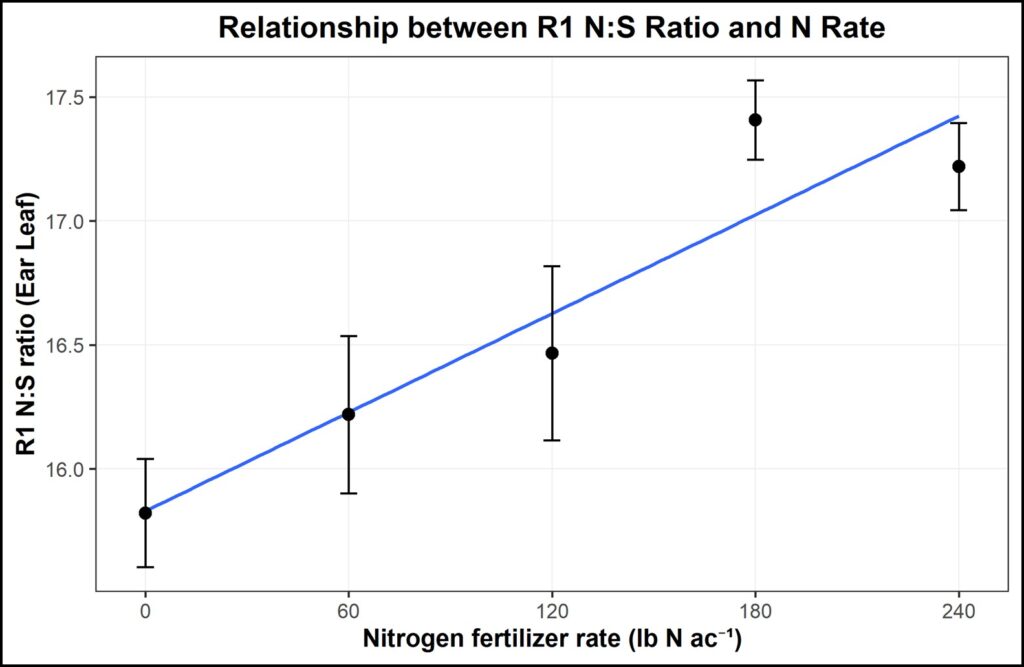
As N fertilizer rates increase, plant tissue N:S ratios also tend to rise (Figure 1), which may exacerbate S deficiency symptoms when S availability is inadequate. Current Purdue University guidelines for diagnosing S deficiency in corn tissue include S concentrations below 0.18 percent and N:S ratios greater than 16:1 in both young vegetative whole-plant samples and R1 ear leaf samples. When tissue S concentrations fall below this threshold and/or N:S ratios exceed 16:1, S deficiency is likely limiting in the plant and S fertilization is likely needed.
Recent Indiana nitrogen and sulfur research
In 2025, field research trials were established at the Agronomy Center for Research and Education (ACRE) in West Lafayette and the Pinney Purdue Agricultural Center (PPAC) in Wanatah, Ind., to better understand N and S interactions in corn.
These studies are also a part of a much larger, multi-state effort led by Oklahoma State University which hopes to provide further insights into N and S interactions of corn across a wider geographic region.
Treatments included five N fertilizer rates (0, 60, 120, 180, and 240 pounds N/acre applied as pre-plant broadcast urea) with and without S fertilizer (24 pounds S/acre applied as broadcast ammonium sulfate). Total N fertilizer rates applied were balanced across all treatments (with and without sulfur), and research treatments were replicated six times at each location.
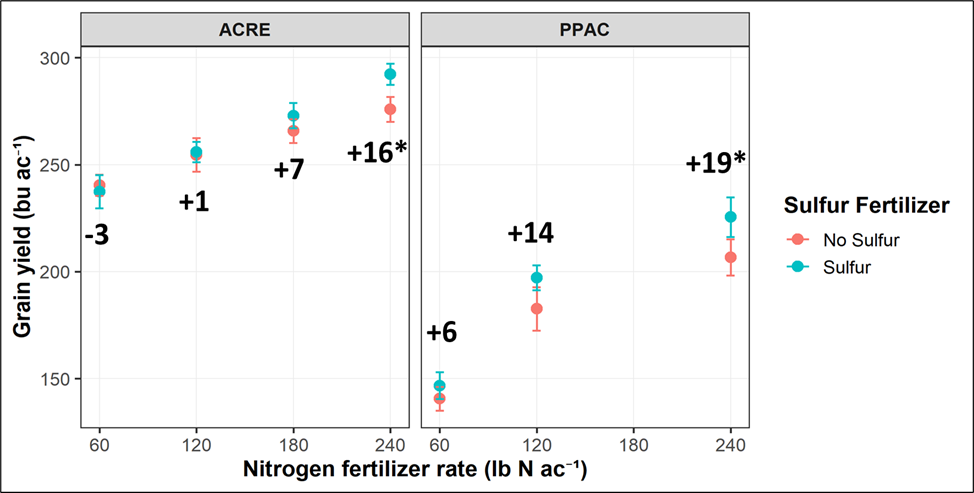
Across both Indiana locations, S fertilization had minimal yield response at low N rates but yield response to S application increased as N rate increased (Figure 2). At the highest N rate (240 pounds N/acre), the inclusion of S fertilizer increased corn yields by approximately 16 to 19 bushels/acre.
In contrast, yield responses to S were minimal or nonexistent at lower N rates. Overall, these results suggest that S fertilizer response may increase alongside increasing applied N fertilizer rates in corn.
Plant tissue responses tell the story
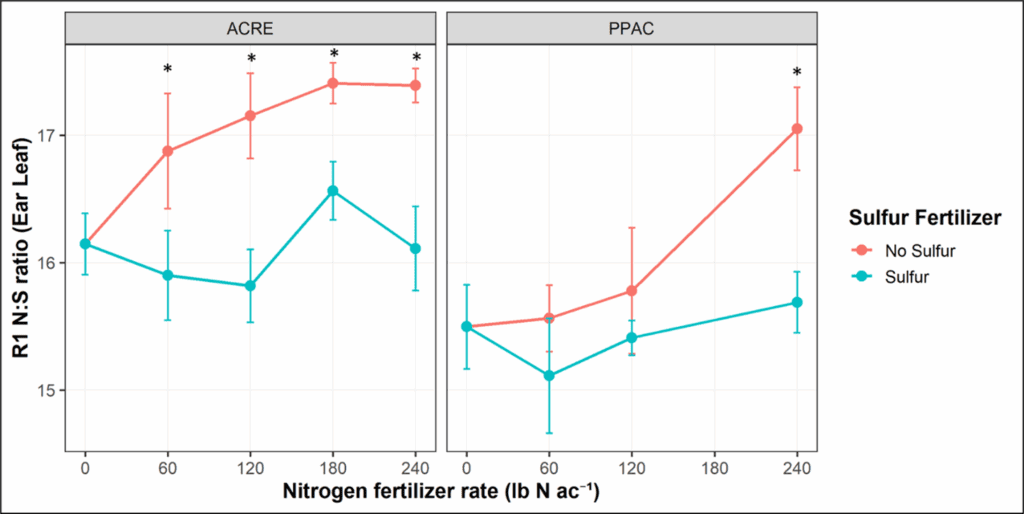
In addition to grain yield data, plant tissue samples were collected at corn growth stages V7 (whole-plant) and R1 (ear leaf) to provide further insight into why the observed yield responses occurred. Overall, S fertilization reduced plant N:S ratios, most notably at higher N rates, indicating improved nutrient balance within the plant (Figure 3).
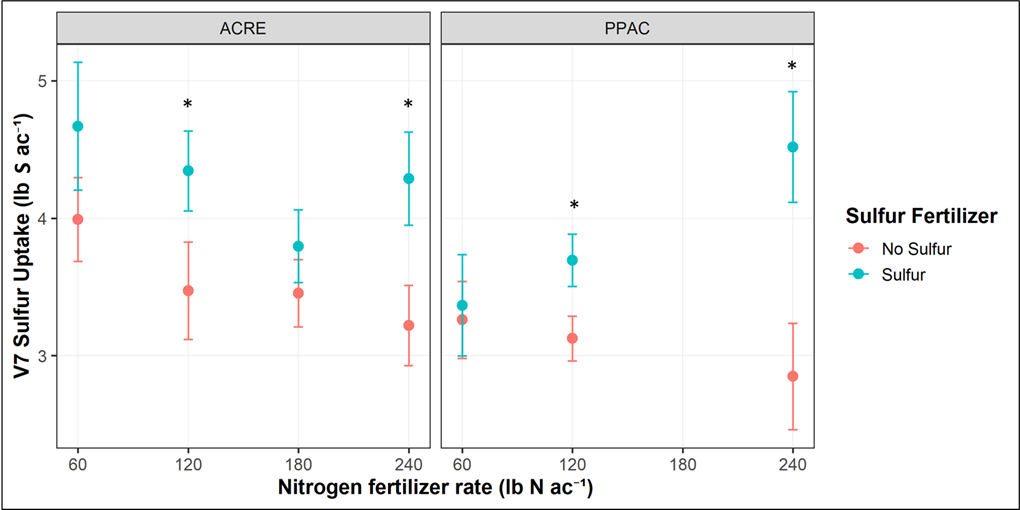
In addition, it was also noted that total S uptake (pounds S/acre) in the V7 whole plant samples decreased as N fertilizer rate increased, and the magnitude of S uptake treatment differences with S fertilizer applied was the greatest at the highest N fertilizer rates applied (Figure 4). These responses further reinforce the concept of how N and S availability and supply interact within the corn plant specific to nutrient uptake and use efficiency.
From a management perspective, our preliminary results indicate that S deficiencies may be more likely to limit yield at higher applied N fertilizer rates. Across sites, the largest yield responses to S have generally occurred at the highest N rates, while S responses diminish as N rates decrease. This pattern suggests that in corn systems with high N requirements or aggressive N management, close monitoring for S deficiency may be particularly important to protect yield and N use efficiency.
These findings also raise important management and research questions. For example, should S fertilizer rates increase as N rates increase, or do S requirements decline as N rates are reduced? Answering these questions will require additional multi-year, multi-location research.
More broadly, this interaction has implications for how N rate studies and on-farm decisions are interpreted. If S is limiting, current N response curves may underestimate true N fertilizer rate response. Ongoing research is focused on clarifying these interactions to improve nutrient management recommendations and ensure that N and S investments are used as efficiently as possible.
This N and S research will continue in Indiana through 2026 and 2027 and will be combined with a larger multi-state effort to strengthen regional recommendations. Future studies will look to evaluate multiple S rates, improved diagnostic tools, and sensor-based approaches to detect S limitation earlier in the season. As N requirements continue to increase in modern, high-yielding systems, S management may play a larger role in maintaining N efficiency and optimizing yield potential.
Continued research and field observations will help refine recommendations and ensure that fertilizer inputs are working together and not against one another.
Posted: January 27, 2026
Category: ICMC, Indiana Corn and Soybean Post - January 2026, Purdue Extension, Sustainability