Timely soybean planting one of top decisions to influence yield potential
By Shaun Casteel, Purdue Extension Soybean Specialist
Timely planting of soybeans is one of the top decisions to influence yield potential and profitability. The evidence has been mounting for years with soybeans as a front runner when deciding between planting soybeans or corn first. Soybean genetics, seed treatments (fungicide in particular), and moments of field suitability have opened this possibility relative to historic guidelines (Table 1).
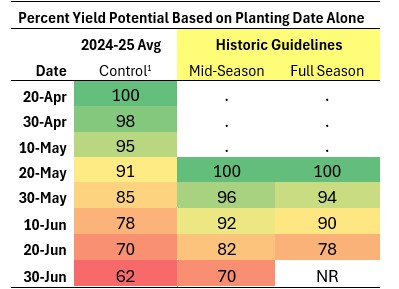
Late April to early May is generally my sweet spot to maximize soybean yield potential based on planting date alone. Obviously, this changes based on field conditions and latitude – earlier plantings are feasible as you travel south.
I want to draw our attention to variety selection with seed treatments as well as germination scores. If you want to continue down the road of timely planting of soybean (and in some cases early planting), the field conditions are often borderline in regards of soil temperature and soil moisture.
We normally consider soil temperatures of 50 degrees F. and rising as the signal to start planting. We have certainly had some of these conditions in March to April in the past few years, but they last a few days to a week or two at best.
After a couple weeks, we start to second guess our decision to plant when we did. Stand establishment will depend on your field conditions (soil temperature, soil moisture, residue), variety and seed treatment. Soybean seeds absorb water (imbibition) based on good soil to seed contact and the moisture present to start the germination process. The risk of imbibitional chilling injury is highest as the seeds absorb “cold” water (less than 50 degrees F.) during the first 12-24 hours.
If soybean seeds imbibe “warm” water (above 50 degrees F.) in the first day, the risk of imbibitional chilling injury is reduced even if the soil water temperatures dip back down in following days or weeks.
Standard seed tags will have the warm germination score, which is simply the percent of seeds that will germinate and develop normally after seven days under ideal conditions – 77 degrees F. and adequate water. We usually accept 90 percent germination (warm, that is) as good or normal seed lot, and we go about our seeding rate and planting as normal.
We all have experienced seed lots that were more like 80 to 85 percent germination and thus, we increased the seeding rates in those situations.
Seed testing evaluations
Seed testing labs can provide other evaluations that may be beneficial if you are choosing to plant early or know that you have fields that tend to be more prone to adverse conditions stand establishment.
Examples include accelerated aging, tetrazolium and cold germination that you can discuss with the lab directly. A cold germination test is one to consider so you can select varieties and/or seed lots that can withstand more cold stressed conditions in your earlier plantings.
This evaluation is not standardized across seed testing labs, so ask the lab what cold conditions do they create to evaluate the seeds.
For example, one lab wets the germination towel in a cold room for at least two hours at 50 degrees F. then “plants” the seeds on the towel, cover with sand, place in cold room at 50 degrees F. for seven days then transfers to a warm room at 77 degrees F. (same as the warm germination test) for another seven days. After the 14 days (seven days of cold and seven days of warm), seedlings are counted for normal, abnormal, or dead.
Cold germination score
This cold germination score provides a better indication of how the seeds perform under those adverse conditions. It is entirely possible to have two seed lots with 90 percent warm germination scores, but cold germination scores of 75 percent for seed lot A and 80 percent for seed lot B.
I suggest using the seed lots (e.g., seed lot B) that have the higher scores under one of these “adverse” conditions when your field conditions may be marginal or the forecast is not as promising. In other words, when the temperatures and the moisture conditions would be more stressful for the soybean seeds.
I would also be sure to include a good fungicide seed treatment for these same fields as this environmental stressful condition is also prime for many of our seedling diseases. You can also manage some of those disease risks based on the variety resistance or tolerance.
I wish you the best of luck as we prepare for the 2026 planting season.
Posted: January 27, 2026
Category: Indiana Corn and Soybean Post - January 2026, ISA, News, Purdue Extension, Purdue University