Martin retires from Purdue after distinquished career
Longtime Purdue University faculty member Dr. Marshall Martin, who was a general liaison between the Indiana Soybean Alliance, the Indiana Corn Marketing Council and the Purdue College of Agriculture, retired in December with a resume of diverse roles exceeded only, perhaps, by his list of accomplishments during his time serving in those roles.
“I have been privileged to work with some of the best academics and scientists in the world,” Martin said. “I have enjoyed this opportunity and challenge.”
Like many career agriculturalists, he knew early that he wanted to aim his life and career toward agriculture. He grew up on an Illinois farm of modest acreage where he worked with his father caring for livestock and crops. He was active in 4-H and FFA as a teenager and, over the years, gained a deep admiration of farm machinery. In fact, he initially enrolled at Iowa State University in ag engineering with the intention of designing farm equipment.
“I discovered over time through my coursework that economics and the application of mathematics and statistics to agricultural problems was more interesting to me than engineering graphics,” Martin explained.
His passion for farm technology remained, however, and his career as a whole has revolved around farm economics related to the adoption of ag technology. He graduated from ISU in 1966 with a major in agricultural business and economics and a minor in ag engineering. He met his wife, Berdine, at ISU; she graduated with a bachelor’s degree in home economics education in 1962. They both earned master’s and doctorate degrees from Purdue, where Martin completed his with a thesis on farmer adoption of cotton harvesters, and it was nationally recognized.
He reached the rank of full professor in 1990 and became chair of the Graduate Admissions Committee. Following this, he had several titles in the College of Agriculture, including associate department head of Agricultural Economics and senior associate director of Agricultural Research and Graduate Education.
Martin taught all manner of graduate and undergraduate classes related to ag economics, including aspects of ag policy and research. He taught more than 3,500 students in his classes during his career, and supervised more than 60 graduate student research theses.

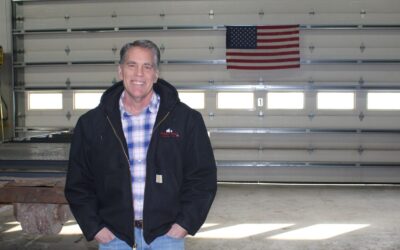
Dr. Marshall Martin is at home in both his office and in the “field office” of a tractor.
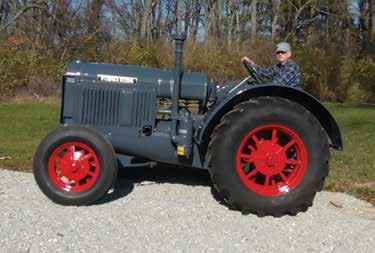
Dr. Marshall Martin has always enjoyed antique farm equipment, and he expects to continue that hobby during his retirement. Martin and his wife, Berdine, have operated a U-pick blueberry farm near West Lafayette since 1990.
He is keenly interested in ag technology ranging from mechanization to crop and animal genetics, to fertilizer and pest management. He is hands-on with this tech because he also farms – he is responsible for a 1,600-acre farm that he coowns with a former student, Kristy Welch. Martin and Berdine have operated a U-pick blueberry farm near West Lafayette since 1990.
As a side effect of his interest in farm tech, Martin is a prolific collector of antique tractors, and has displayed his collection at events such as the Half-Century Progress show in Rantoul, Ill., and the American Soybean Assoc. 100th Anniversary in Camden, Ind., last year. In retirement, he plans to collect more tractors, “as long as there is space in my machine shed.”
His career has also been occupied with observing ag technology adoption in other cultures. Following their marriage in 1966, the couple spent five years in Bolivia where he taught vocational agriculture in Spanish and was director of the K-12 Instituto Rural de Montero, consisting of 400-plus students and 40 teachers.
At the same time, he taught community development at Wesley Seminary to future Bolivian Methodist pastors. As part of his PhD coursework, Martin spent a year speaking Portuguese at the University of Sao Paulo and served as a research advisor for Brazilian graduate students.
“My wife and I are very concerned about people having an education, being able to produce food, to consume a nutritious diet, to get an education and job, being able to pay for their family expenses,” he explained. “And part of the answer is education, providing opportunities for people to have jobs – so we’ve always been concerned not only with getting food to people in other countries, but in this country as well.”
In addition, he has lived in Costa Rica and made 17 trips to

They said it . . .
Past ISA Chair David Rodibaugh: I had known Marshall for some time before his service with the Indiana Soybean Alliance. He has a wide and interesting range of experiences and shares good stories along the way. He has been able to organize helpful connections with Purdue staff for farmer organizations.” Jay Ackridge, Provost and Executive Vice President for Academic Affairs and Diversity at Purdue University: “I have known Marshall for nearly 40 years – first as one of my professors, then as a faculty colleague in the Department of Agricultural Economics, then working with him as an administrator while I was Dean, and more recently, in my role as Provost. Marshall has been a true role model for what it means to be a faculty member at a land-grant university. … His work ethic is legend, and his passion for agriculture unparalleled. While Marshall enjoyed a stellar academic career, he is truly a farmer at heart. Marshall likes nothing better than getting on a tractor for field work. That passion for helping our farmers be more informed, more successful, infused everything he did at Purdue.” Karen Plaut, Glenn W. Sample Dean of Agriculture at Purdue University: “Marshall is a friend and colleague that I value dearly because he cares about people. … Marshall is a very kind person. I always tell people he has a heart of gold. He will do anything for anyone. His goal is always to make other people shine through helping them. He also is an extremely hard worker. He will work long days in the office and then go and work at his blueberry farm or help a neighboring farmer. He has unbelievable energy and is a resource to everyone.”
Argentina, 11 to Brazil and has been at least once each to the countries of Spain, Mexico, Netherlands, Egypt, Russia, China, Venezuela, Colombia, Italy, Cuba, Peru, India, Portugal, Hungary, Austria, Belgium and Switzerland. On some of these trips, he accompanied the ISA as a leader and/or translator.
Though he can certainly count himself an economist, agriculturist, researcher and servant-leader, Martin sees himself mostly as a teacher.
“I have always enjoyed teaching the next generation of farmers and agricultural leaders in Indiana, the U.S. and around the world,” he said. “I gain most of my satisfaction in following the career and accomplishments of my former students. With my recent retirement, I have been both humbled and honored by the unsolicited letters, cards and email messages from former students.”
Martin said former students often mention his caring attitude, his encouragement to them professionally and the many semesters he and his wife hosted entire classes in their home during the fall semester. Students often appreciated his scholarship, integrity and politeness in interactions with them, even beyond graduation. He hopes his epitaph might read: “He Listened, He Taught, He Cared.”
But his former students were not the only ones to enjoy Martin’s company in pursuing agricultural excellence – he also acted as a Purdue liaison to numerous professional ag groups, the members of which agree he is pleasant to work with.
“Dr. Martin was generous with his time and expertise at the board meetings and with me personally,” said ISA and ICMC CEO Courtney Kingery. “His deep passion for education and agriculture became apparent to me immediately. He shared with me his experience working with farmers all over the world to improve their production and yields.”
Along with the ISA and the ICMC, he has worked with the Indiana Pork Board and Indiana Crop Improvement Assoc., among others. Kingery’s executive assistant, Chris Weldon, said though Martin’s curriculum vitae is long and distinguished, he has never acted with the least pretension.
“My role is not one in the spotlight, yet he made it a point to never leave without coming up to me and thanking me for the behind-the-scenes work and preparation I put into our board meetings,” Weldon said. “He didn’t have to do that, but he did, every time.”
Though he is not going completely off the radar, Martin will deeply miss his daily interactions with students, faculty, administrators, colleagues and directors and staff of various other stakeholder organizations. Kingery said while Martin has global reach, he also understands that agriculture requires hard work from individuals, who should be valued even more than the ever-changing technology they handle.
“He understands deeply that while in agriculture we address big global issues like hunger, food security and sustainability – at the root of it, there are individual people doing the work,” she noted. “And it was the people of agriculture to whom Dr. Martin gives his heart and his life’s work.”
Posted: October 28, 2022
Category: ICMC, Indiana Corn and Soybean Post - Winter 2021, ISA