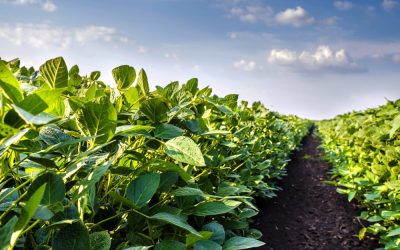
Rulon farm embraces conservation to improve soil health, bottom line
By Amie Simpson
For more than 30 years, a fifth-generation farm family in Arcadia, Ind., has been embracing conservation practices, benefiting not just their land and bottom line, but also their community.
Rulon Enterprises consists of Rodney Rulon and his cousins, Ken and Roy, and Roy’s sons, Nick and Neal. The family has seen improved soil health on the farm and water quality in neighboring streams through no-till, cover crops, nutrient management and variable rate technology.
“We’ve seen on-farm success by improving overall soil health, keeping those nutrients where we want them, and improving water quality,” Rodney said. “We’re seeing environmental and economic benefits. For example, cover crops as part of a system have improved crop production and yield.”
Getting started
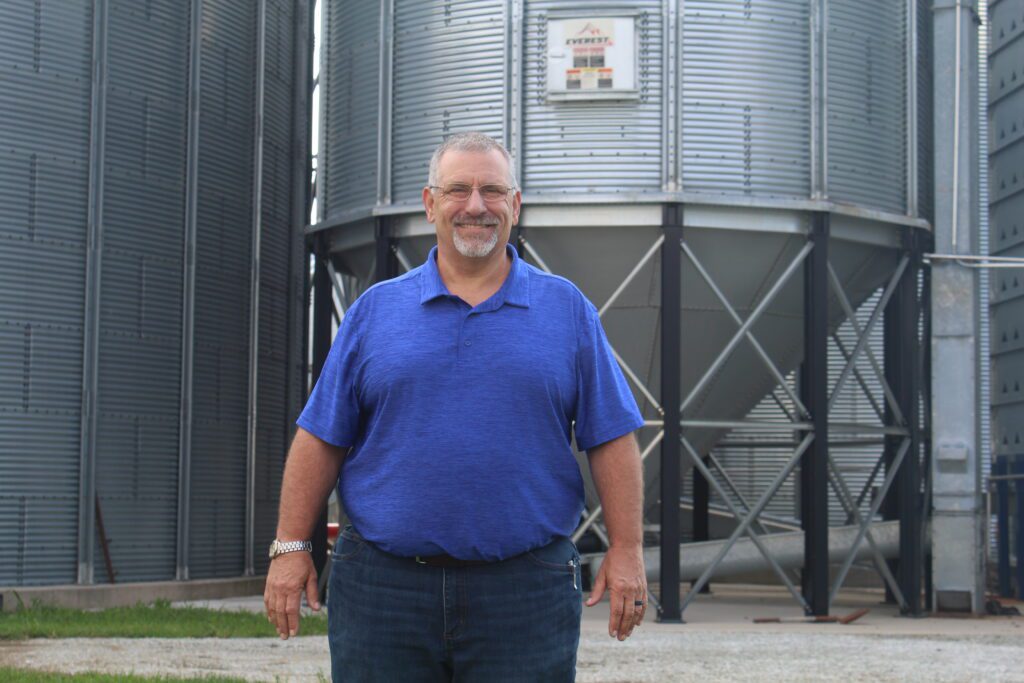
Rodney grew up working with his family on the farm and returned full-time after graduating from Purdue University. He noted that his family has always been open to trying out conservation practices. They began no-tilling corn and soybeans in 1989 and planting cover crops in 2001. Today, they plant cover crops on 95 percent of their acres.
“I was starting college when we began transitioning to no-till. My uncle and cousin were tired of seeing the soil wash away in nearby streams after rainfall,” Rodney said. “They wanted to increase soil organic matter and keep that soil in place while reducing labor and equipment costs and maximizing profitability.”
After several years of no-tilling and establishing buffer strips along streams and drainage ditches, the Rulons saw improvements. They began building on that success by completing one-acre grid fertility testing and variable rate applications to further improve soil health and crop yields.
“It felt like we were a little stagnant at that point. I then attended The National No-Till Conference in the early 2000s and spoke to some of the experienced farmers about what they were doing to improve soil microbiology,” Rodney said. “That’s really where we got the idea to start planting cover crops.”
As with any new practice, progress takes time and can often feel like trial and error. Rodney said it was a learning process that took about five years to find the right mix for their soil, planting dates and goals.
“It helped that we had resources. In addition to the National No-Till Conference, we attended soil and water conservation district meetings, followed Purdue University research findings from Eileen Kladivko and others, and worked with soil consultant groups,” he said. “Face-to-face meetings with farmers were the most helpful. My cousin, Ken, developed a peer network for our farm where farmers could come together a few times a year to share both successes and problems among peers.”
Utilizing research to make decisions
Managing these practices as a system and adapting to changes continue to be a priority. Rodney manages the farm’s soil sampling and fertility, conservation programs and more.
“Today, we’re managing our nutrients with our system in mind and selecting hybrids specifically for no-till and this environment,” he said. “We are no tilling and planting cover crops on nearly all our acres and have less waterways and other ‘conservation band-aids’ on our farms because of these different practices.”
The Rulons have been conducting on-farm research for years.
“In the last 15 years we’ve worked with Purdue on side-by-side tests comparing different cover crops vs. no cover crops,” Rodney explained. “We put out several test plots where we track for our own management of inputs. Because of my background, I manage most of these tests. When we figure out what does and doesn’t work, we have the data to back it up.”
He added that the on-farm research gives them confidence in making decisions that are right for their farm.
“Every time we do a strip test or side-by-side field test, success comes down to a return on investment, not just yield,” he said. “We trace everything back to what did the practice cost us per acre to implement.”
Fulfilling a need
Rodney is one of the farmer leaders of a new conservation program called Farm Advisors, which connects interested farmers with someone who’s successfully implemented conservation practices on their operation.
“A group of Indiana farmers got together and wanted to pay it forward by sharing what they’ve learned over the years,” he said. “Farm Advisors was created as a way to fill some gaps in conservation adoption by having farmer mentors share some of the things that have worked, what hasn’t, and provide an opportunity to bounce ideas off one another.”
The goal is to improve conservation on the ground and provide resources to prevent farmers from abandoning a practice because of a negative experience.
Interested farmers can sign up to start these conversations by visiting www.farmadvisors.ag.
“Once you sign up, you’ll receive a call from a Farm Advisors representative to find out more information about your farm, goals, and what issues you’re trying to address,” Rodney said. “We’ll then match you with someone who can talk to your farm and soil types.”
Rodney said he’s excited to see how the program grows and the positive ripple effects that it will have throughout Indiana agriculture and the community.
“Farming is a way of life. I have a deep appreciation for our farming family, the environmental benefits and legacy that come from working to leave the ground we farm better than we found it for our kids and future generations,” he said. “We’ve been an active part of this community for five generations and have worked hard to improve water quality and soil health. We’re located just north of Indianapolis, near the Morse Reservoir, so doing this for not only my farm, but the wider community is important to us.”
Posted: September 13, 2025
Category: Conservation Case Study, ICMC, Indiana Corn and Soybean Post - September 2025, ISA, News, Sustainability