Weather, tar spot, nematodes add up to challenging planting season
By Scott Gabbard, Purdue on the Farm Senior Administrator

By the time many of you read this, some fields will already be tasseling, while others may have just received their sidedress application. It’s been quite a season, so far.
Running some ag climate numbers recently, from April 1 to July 1, 2025, the northwest counties near Lake Michigan are 4.5 inches behind the 30-year average in precipitation. Meanwhile, a cluster of 10 counties from Sullivan to Shelby are up to 12.5 inches above their typical rainfall for this period. The when and how much is a story for someone else to tell.
The data is rolling in. Pictures — both drone and ground-level — are being uploaded. Educators across the state are walking fields and working closely with farmers. At the time of writing, 34 soil test reports have been completed, with more arriving in my inbox daily.
Soybean nematode tests are also trickling in. Like every year, this one is unique. In 2024, one-third of the soybean fields analyzed showed low levels of cyst nematodes, and no region of the state was immune.
The same variability applies to crop emergence. Crop insurance claims have been more frequent than any of us would like. Still, the Indiana crop is progressing, and we’ll continue working with specialists, farm partners and others — through social media and other channels — to provide research-based information aimed at keeping corn and soybean production as profitable as possible during these challenging times.
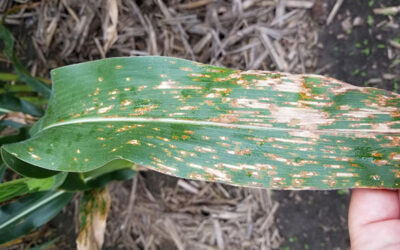
Last year, educators across the state helped Dr. Darcy Telenko and her team confirm tar spot in every county. Looking at the maps, we’re the only land-grant system in the Corn Belt to achieve this. Since tar spot is widespread, understanding how it “ticks” and managing it effectively is more important than ever.
This year, educators are again stepping up to assist Dr. Telenko. With support from checkoff dollars, spore traps have been placed throughout the state. Every two weeks, specimens will be collected and frozen for further analysis this winter.
As the soil sampling phase winds down, we’ll begin collecting foliar samples during the second round of field scouting. In corn, we’ll sample the ear leaves. In soybeans, we’ll test the uppermost mature trifoliate, typically the trifoliate at the third node from the top of the main stem.
This is a critical time for both corn and soybeans. While the number of rows around the cob is already set, the number of kernels to pollinate, and how well the tip fills out, is still to be determined.
Soybeans have a longer window for pod production, but as we learned last year, adequate moisture is still essential for pod fill.
As crops enter the reproductive stage, this is also a key time for disease assessment. While we’ve already received some samples related to emergence and wetness issues, foliar disease detection and timely management are crucial.
Purdue On The Farm was created to help farmers get answers to their questions. These relationships take time and communication. That said, we have planting, treatment and conservation practices in place across the state to help farmers draw their own conclusions. It’s an exciting time — stay safe out there, and happy scouting.
Posted: July 19, 2025
Category: ICMC, Indiana Corn and Soybean Post - July 2025, ISA, News, Purdue University, Research